
So you want more corporate tax clients. Most firms jump straight to the channel. Should we run Google Ads? Should we do SEO, LinkedIn, Facebook?
But the reality is, before we decide how to sell corporate tax, we need to decide two things first: our positioning and our offer. Corporate tax is one of the most commoditized services an accounting firm sells. And the more commoditized a service is, the more compelling your offer needs to be. If you skip that step, it doesn't matter which channel you pick.
Why corporate tax is a commodity
From the business owner's point of view, a corporate tax return (a T2 in Canada, a Form 1120 or 1120-S in the US) looks the same no matter who files it. It's due once a year, it needs to be accurate, and at the end of the day the result is a filed return.
Now, you know the difference between a careful preparer and a careless one. Your prospect usually doesn't. So when they compare three firms, they compare the only things they can actually see: price, how fast you get back to them, and how easy you seem to work with.
That's what commoditized means. It doesn't mean the work is easy. It means the buyer can't tell the providers apart. And when they can't tell you apart, they go with the cheapest option, or the first firm that calls them back.
When I've audited Google Ads accounts, I've seen this time and time again. Every firm is bidding on the same broad keywords, "corporate tax accountant," "small business accountant," and every ad says the same thing: book a free consultation. The cost per click keeps going up, and the only people clicking are price shoppers.
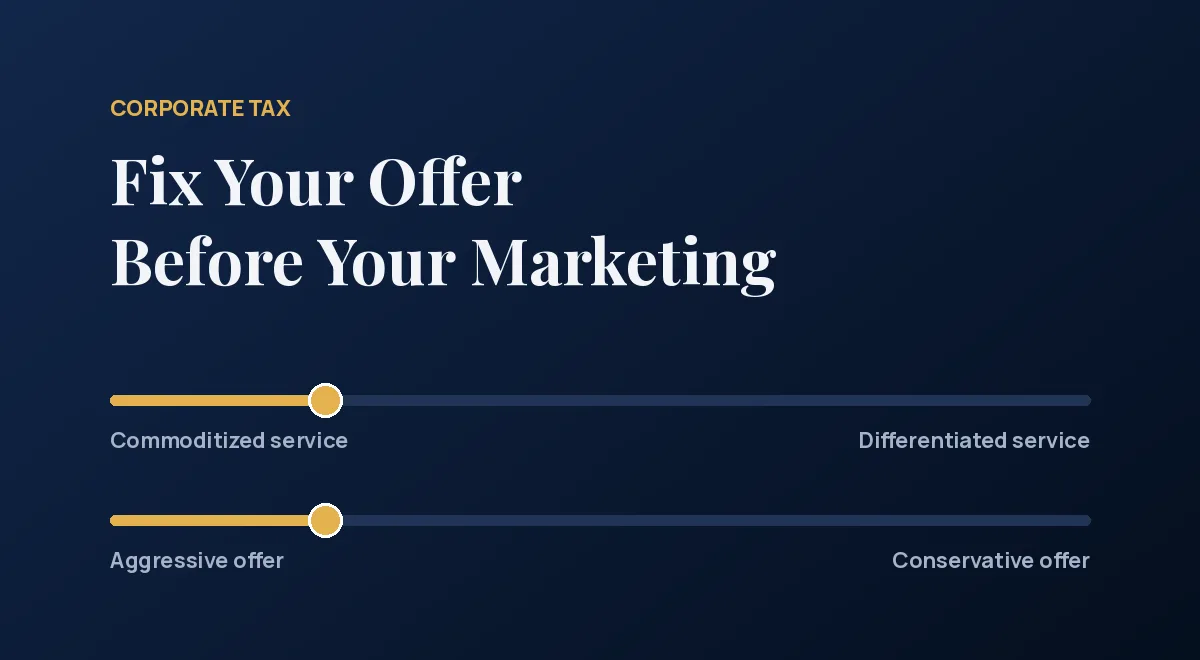
The two dials: how commoditized is your service, and how aggressive is your offer?
The way I like to explain it is with two sliders.
1. How commoditized is your service?
2. How aggressive is your offer?
The further left your service sits on the first slider, the further left your offer needs to sit on the second.
Let's say you're one of a handful of firms that handles cross-border tax for US citizens living in Canada. "Book a free consultation" is enough. The prospect doesn't have many options, and they're already motivated to find you. That's a differentiated service, so a conservative offer works.
Now compare that to corporate tax. A business owner can find 200 firms in their city that file corporate returns. "Book a free consultation" gives them no reason to choose you, because everyone's offering that. So your offer has to do the differentiating that your service can't.
| Row | Conservative offer | Aggressive offer |
|---|---|---|
| Differentiated service | Works. A consultation is enough | Usually leaves money on the table |
| Commoditized service | Struggles. You blend in with every other firm | Works. The offer gives them a reason to pick you |
Most firms selling corporate tax are sitting in the bottom-left box. And that's the box where marketing feels expensive and nothing seems to work.
Step 1: Positioning comes before the offer
There are two ways out of that bottom-left box. You can make your offer more aggressive, or you can make your service less commoditized. The second one is cheaper, so that's where I'd start.
The days of being a general accountant are over. Positioning simply means choosing who your corporate tax service is for. "Corporate tax for small businesses" is a commodity. "Corporate tax for incorporated dentists" or "corporate tax for construction contractors" isn't, at least not to a dentist or a contractor.
I have a client who focuses on crypto investors and day traders. We tested a few angles, found there was a huge market opportunity there, and he went all in on it. Not many firms knew how to serve that client, so he wasn't competing with every accountant in town anymore.
A niche does three things for you:
- It changes who you're competing with. Instead of every firm in your city, you're competing with the few that actually speak that industry's language.
- It makes your messaging a lot sharper. People don't care who you are until they know you can help them. A niche lets you talk about their specific problems, like holding company structures or subcontractor payments, instead of generic "tax services."
- It makes your ads cheaper. Niche keywords usually have a lower cost per click and much higher intent than broad ones like "corporate tax accountant."
And you don't have to turn everyone else away. You just lead with one audience in your marketing.
Step 2: Build an offer worth choosing
A compelling offer removes the reasons a business owner would hesitate or keep shopping around. For corporate tax, those reasons are almost always the same. They don't know what it's going to cost. They're worried switching accountants will be a hassle. And they're not sure you'll be any better than who they have now.
Here's a real example. One of my bookkeeping clients was getting lost in the sea of "free consultation" offers. So we ran an offer of two months of free bookkeeping when the client committed to eight months. That one change helped separate him from every other firm in his market.
Here are the levers I see work, from most conservative to most aggressive:
| Lever | What it solves | Example |
|---|---|---|
| Flat, published fee | Fear of an open-ended bill | "One flat fee for your corporate return, quoted before we start" |
| Speed promise | Fear of being ignored | "Your quote within 48 hours of sending us your books" |
| Done-for-you switching | Hassle of changing accountants | "We request your files from your previous accountant" |
| Bundled value | Feeling of paying for a form | Year-end planning meeting included with every return |
| Reduced first year | Risk of trying someone new | Discounted first return when they sign on for monthly bookkeeping |
| Free add-on | No reason to pick you over others | Prior-year bookkeeping catch-up included with an annual engagement |
You don't need all six. Pick the one or two that answer your ideal client's biggest hesitation, and make that the headline of every ad, landing page and sales call.
And you'll notice the more aggressive options all pair the return with something recurring. That's on purpose. The corporate return gets your foot in the door. Monthly bookkeeping, payroll or advisory is where the relationship actually pays you back.
Example: is an aggressive offer worth it?
A lot of partners worry that a discount or a free add-on means giving work away. So let's actually run the numbers on one client. These are just round numbers to give you an idea, not market rates.
Let's say your corporate return fee is $2,500, and monthly bookkeeping is $400.
Conservative offer: "Book a free consultation." A client who signs pays $2,500 for the return. And a lot of these clients only ever buy the return.
Aggressive offer: "First year's corporate return at $1,500 when you start monthly bookkeeping."
| Row | Conservative | Aggressive |
|---|---|---|
| Year 1 return fee | $2,500 | $1,500 |
| Year 1 bookkeeping | $0 | $4,800 |
| Year 1 total | $2,500 | $6,300 |
| Year 2 total | $2,500 | $7,300 |
So you gave up $1,000 on the first return, and gained a client worth almost three times as much in year one. The real question isn't whether you can afford the discount. It's whether you have the capacity to deliver the bookkeeping well.
Step 3: Match the offer to the channel
Now, once your positioning and offer are locked in, the channel decides how much work your offer has to do.
| Channel | How buyers arrive | What the offer needs to do |
|---|---|---|
| Google Ads | Actively searching, comparing several firms | Win the comparison. Lead with your niche and your strongest lever in the headline |
| SEO and AI search | Researching, often not ready to hire | Prove expertise for your niche. Use a soft next step like a checklist or calculator alongside the consultation |
| Facebook and Instagram | Not looking for an accountant right now | Interrupt with a specific problem, then make saying yes feel low-risk. This is where aggressive offers matter most |
| Owners and finance leads, longer decision cycles | Lean on positioning and content. Offers can be more conservative here |
The biggest mistake I see is running the same "book a consultation" message everywhere. On Google, it's competing with ten other ads that say the exact same thing. On Facebook, you're asking someone who wasn't even thinking about taxes to book a meeting. Neither one works well.
Google Ads still works, by the way. But the playbook has changed. You have to be very particular about the keywords you go after, and your offer has to stand out in the ad itself.
Where aggressive offers go wrong
Now, of course, aggressive doesn't mean reckless. A few guardrails I'd keep in mind:
- Don't compete on price alone. "Cheapest corporate returns in town" attracts the clients who'll leave the second someone undercuts you. Tie any discount to a longer relationship.
- Never promise tax outcomes. Give certainty on price, speed and process. Never on how much tax someone will save or what the CRA or IRS will do.
- Check your advertising rules. CPA bodies in Canada and state boards of accountancy in the US have rules around advertising, testimonials and fee claims. Run your offer by them before it goes live.
- Know your capacity. An offer that works can bring in more clients than your team can handle well during tax season. Set a cap if you need to.
- Be upfront about the fine print. If the first-year rate depends on a 12-month bookkeeping commitment, say that clearly. Accounting is a high-trust vertical, and surprises at signing kill that trust fast.
FAQ
How can an accounting firm get more corporate tax clients?
Start with your positioning and your offer, not the marketing channel. Pick a niche you can speak to directly, then build an offer that removes the biggest reason those business owners hesitate, which is usually unclear pricing or the hassle of switching.
Why aren't Google Ads working for corporate tax?
Usually it's because everyone is bidding on the same broad keywords, like "corporate tax accountant," with the same free consultation offer. Niche keywords and a stronger offer in the ad itself tend to bring in cheaper, better-fit leads.
Should accounting firms discount corporate tax returns?
Only when the discount is tied to something recurring, like monthly bookkeeping. A standalone discount mostly attracts price shoppers.
What makes an accounting firm's offer compelling?
It answers the client's biggest hesitation before they even ask. For corporate tax, that's usually a clear flat fee, a fast turnaround, help switching from their old accountant, or extra value like a planning meeting.
Is positioning or the offer more important?
Positioning comes first, because it's cheaper. The less commoditized your service looks to your ideal client, the less aggressive your offer needs to be.
Not sure where your offer sits?
I'm not here to sell you on running more ads. Send me your current corporate tax landing page or ad, and I'll tell you honestly where it sits on both dials and what I'd change first. If it's already strong, I'll tell you that too.
Book a Strategy Call