
When I get on a call with a managing partner, the first thing I usually hear is "we need more leads." And I get it. But from my experience working with accounting firms, most of them don't have a lead problem. They have a leaky bucket.
The backbone of any marketing strategy is the acquisition process. So before we spend another dollar on Google Ads or SEO, we want to quantify every stage between "someone filled out a form" and "signed engagement letter." That's what a bottleneck analysis is. It tells you exactly where clients are falling through the cracks, so you know where to focus your time and your budget.
Leads to clients doesn't paint the full picture
When I ask a firm how their marketing is going, I usually get two numbers. How many leads came in, and how many became clients.
Now, that ratio tells you something is off. But it doesn't tell you where. A 10% lead-to-client rate could mean your ads are attracting the wrong people. It could mean nobody's calling leads back fast enough. It could mean people book and don't show up, or your consultations just aren't closing. Each of those has a completely different fix, right?
And so what I see time and time again is firms default to the most expensive fix: more leads. More ad spend, more SEO, a new agency. But if the leak is in the middle of your funnel, pouring more leads in at the top simply means more leads fall out the bottom.
The 5 stages of your client acquisition process
Every firm's process looks a little different, but most follow the same path. What we want to do is track the count at each stage, and the conversion rate from one stage to the next.
- Leads generated. Anyone who submits a form, calls, or books online.
- Leads connected. You actually had a live conversation with them. Not a voicemail, not an email that never got a reply.
- Consultations booked. They agreed to a proper meeting with a partner or manager.
- Consultations attended. They showed up.
- Clients signed. Engagement letter signed, or first invoice paid.
The stage with the lowest conversion rate is your bottleneck. That's where your next dollar and your next hour should go.
And you don't need fancy software to start. A simple spreadsheet with the last 90 days of leads and a column for each stage is enough. If your CRM already tracks pipeline stages, even better.
Example: 400 leads, 40 clients
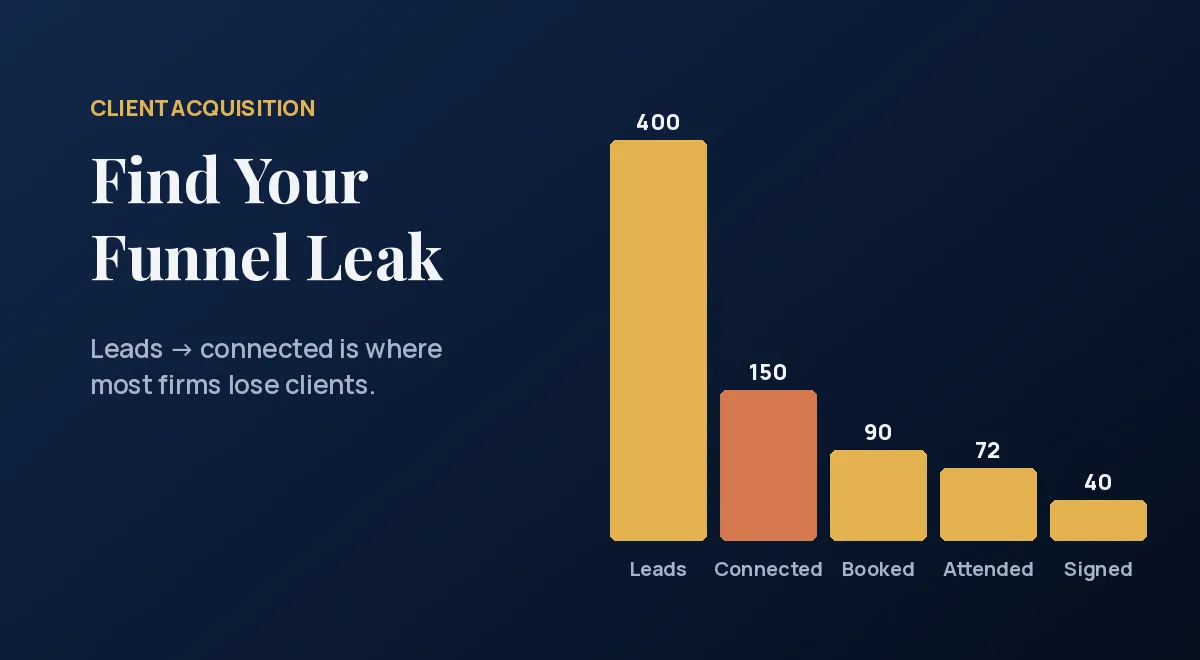
I recently met with a Toronto firm that had generated roughly 400 leads so far this year and signed around 40 of them. So about a 10% conversion rate. Not terrible, not great, and no clear direction on what to fix.
Now let's break that same year into stages. These stage numbers are just to give you an idea, but this is a pattern I see with firm after firm.
| Stage | Count | Conversion from previous stage |
|---|---|---|
| Leads generated | 400 | |
| Leads connected | 150 | 38% |
| Consultations booked | 90 | 60% |
| Consultations attended | 72 | 80% |
| Clients signed | 40 | 56% |
The bottleneck jumps out right away. Booking, attendance and closing all look healthy. But 250 out of 400 leads never had a real conversation with anyone at the firm.
So let's compare two options.
Option A: double the leads. 800 leads at the same rates gets you around 80 clients. But it also roughly doubles your ad spend or content budget.
Option B: fix the connect rate. Let's say we raise it from 38% to 60% and keep everything else the same. Now 400 leads becomes 240 conversations, 144 bookings, around 115 meetings attended and roughly 64 clients.
That's 24 more clients a year from leads you already paid for. And once the bucket stops leaking, Option A becomes a lot more profitable.
How to fix a low connect rate
From my experience, leads to connected is the biggest bottleneck for most accounting firms. And nine times out of ten, it's not a marketing problem. It's a process problem. Here are four ways we can improve it.
Number one, filter out low-quality leads. If your lead form only asks for first name, last name, email and phone number, it doesn't pre-qualify anyone. So a very simple example: if you only want to work with businesses doing $100,000+ a year, because you know they can afford your services, ask that in the form. I would turn your lead form into a short survey, and use conditional logic to route anyone below that number somewhere else. You'll get fewer leads, but your team spends its time on people who can actually hire you.
Number two, call within minutes, not hours. This one has made the biggest difference with my clients. A Harvard Business Review study found that firms who contacted a lead within an hour were nearly 7 times more likely to qualify that lead than firms that waited even an hour longer. And the reason being is, in a world full of distractions, someone fills out your form while scrolling Instagram or searching on Google. If you call them right away, they're far more likely to pick up. And if they're reaching out to other accountants too, they tend to go with the first one who actually connects with them. You skip the whole bidding war.
Number three, give one person the job. In a lot of firms, a new lead gets manually assigned to whichever partner has capacity, and that partner follows up when they can. That's how leads sit for two days. One of my clients hired a client coordinator whose only job is to call new leads fast and book them with the right partner. Partners stopped chasing leads and went back to doing consultations.
Number four, follow up more than once. Calling a lead once and leaving a voicemail simply isn't enough. You have to balance not pestering them with being persistent and proactive. So build a short follow-up process: a call and a text right away, then a few more touches over the next week by phone, text and email. Most of the leads you think went cold just never picked up the first time.
Fixes for the other stages
Now, your bottleneck might be somewhere else. Here's where I'd look first at each stage.
| Weak stage | Likely cause | First fix to try |
|---|---|---|
| Leads generated | Broad keywords and generic messaging attract price shoppers | Target narrower, high-intent searches and speak to one client type's actual problem |
| Connected to booked | The first call feels like a sales pitch | Lead with their situation, then offer a short meeting as the obvious next step |
| Booked to attended | Too much time between booking and the meeting | Book within 48 hours, send reminders, and send a short intro video from the accountant they'll meet |
| Attended to signed | Unclear pricing, scope or next steps | Show fees and a simple engagement plan in the meeting, then follow up the same day |
The goal isn't to fix everything at once. Fix the weakest stage, measure again in 60 to 90 days, then move on to the next one.
Track revenue by channel, not just leads
At the end of the day, leads are a vanity metric. What you really want to know is which channel is bringing in revenue.
Let's say Google shows 10 leads and all 10 closed. Facebook drove 50 leads, but only 2 closed. If you only look at lead volume, Facebook looks like the winner. Look at revenue and it isn't even close. But you won't know that until your leads are tagged and segmented properly.
There are two ways to track where your leads are coming from:
- Self-reported attribution. As simple as adding "How did you hear about us?" to your lead form. Letting the person tell you where they found you is a great way to get a general idea.
- Data attribution. Tag every marketing channel so your CRM pulls that data in automatically. Then you can see which channel drove the most revenue, not just the most leads.
I recommend using both. And here's why. Accounting is a high-trust vertical. People are sharing their personal finances with you. So no matter where someone first hears about your firm, a podcast, a LinkedIn post, a referral, they're probably going to Google you or ask ChatGPT before they reach out. Your analytics then gives Google all the credit, and you end up underinvesting in the channel that actually did the work.
What I'd do this week
- Pull the last 90 days of leads from your CRM or inbox
- Mark each one: connected, booked, attended, signed
- Calculate the conversion rate between each stage
- Circle the lowest one. That's your bottleneck
- Pick one fix for that stage and give it 60 days before you judge it
And if you can't fill in those columns because nobody tracked whether a lead was ever reached, that's your first finding right there.
FAQ
What is a bottleneck analysis for an accounting firm?
It's breaking your client acquisition process into stages (lead, connected, booked, attended, signed) and putting a conversion rate on each one. The stage with the weakest rate is your bottleneck, and it's usually the cheapest place to win more clients.
What's a good lead-to-client conversion rate for an accounting firm?
It depends a lot on the service and where the lead came from. Referrals close much higher than cold paid leads. So instead of chasing an industry average, compare your own stages against each other and track the trend over time.
How fast should an accounting firm respond to a new lead?
As fast as possible, ideally within minutes. Research published in Harvard Business Review found firms that responded within an hour were nearly 7 times more likely to qualify the lead than firms that waited longer.
Should I spend more on ads if my firm isn't getting enough clients?
Not until you know where your funnel is leaking. If most of your leads never get a real conversation, more ad spend just means more wasted leads.
How do I know which marketing channel is bringing in clients?
Ask every lead how they heard about you, and tag your campaigns so your CRM records the source. Then look at signed clients and revenue by channel, not just lead volume.
Want me to take a look at your numbers?
I don't just look at leads. I look at the full acquisition process, because that's where the revenue is. Send me your last 90 days of lead data and I'll map out your five stages and show you where clients are slipping through the cracks. And if your funnel is already in great shape, I'll tell you that too.
Book a Strategy Call